20 October 2008

Brief Update on Things to Come (Hopefully)

Teaching four days a week and writing the other three is wiping me out, leaving little time (or an unoccupied piece of mind) to write. That said, I do have a draft lined up about what I'm calling the "Indian Fashion Show 2008," about the Smithsonian exhibit of 19th century Native American women's garments that recently opened in New York City. I also received Lookbook 54 from Brooklyn-based artist Emily K. Larned (in collaboration with photographer Roxane Zargham), which features 54 ways to style a plain white t-shirt (which is a wonderful commentary on the tensions between standardization and individuation in fashion discourse), and the gorgeous coffee table book of the textile- and mostly installation-based art of Yinka Shonibare MBE. Amazing! I saw some of his pieces on the campus visit to my university, which I took at the time to be a good, good sign.


Meanwhile, here's some of what I've been reading and thinking about in the fashion blogosphere.

* A fight broke out on Jezebel about "gothic Lolita" fashion, with lots of accusations of infantalization and pedophile-baiting. In response, a Gothic Lolita fan wrote a mini-manifesto, which again sparked an intense argument about fashion and feminism, and whether or not one's sartorial or beauty choices can tell us anything about one's political capacity. I found these discussions fascinating for their conflation of moral and aesthetic judgments with political and intellectual ones. Someday I may write a post about how those who would portray some women as "duped," "irrational," or "passive victims" because of their sartorial or beauty choices must consider how such a stance assumes a "superior" and rational perspective that erases or dismisses other modes of explanation or engagement with these bodily practices. Instead, I'd argue that such choices can also be complicated signs and forms of negotiation or meaning-making that do much more than, say, create legions of pedophiles or otherwise figure as outward manifestations of stunted "maturity." In any case, it did inspire this genius LOLita:


* Counterfeit Chic briefly blogs the Florida judge who determined that a local ordinance against baggy pants are unconstitutional. As she notes, such laws target young black men specifically as this so-called crime. Racial policing thinly disguised as sartorial policing is the new black (and brown, post-9/11).

* Footpath Zeitgeist is back with a couple of useful critiques of hipster-saturated fashion discourses. The first takes on the transnational circulation of "thrifting" as the name not of a practice grounded in local histories, but a style based on a global aesthetic culture. The second examines the problematic valueing, and privileging, of "vintage" as a sartorial practice of distinction and individuation:

Here, 'vintage' means, "I'm too individual to settle for mass-produced new clothes", even though the "vintage" garment was almost certainly worn on a mass scale whenever it was new. More subtly, it also means, "I'm sophisticated enough to redeploy the styles of the past, not just wear whatever's new" and of course, "No, you cannot buy this item yourself, it's all mine."

This quote goes a long way toward explaining some of my recent fashion blog fatigue (which includes most street style blogs, for sure).

* Lastly, I've been listening to the new punk rock advice show You've Got A Problem, the latest production from Maximumrocknroll Radio. Is it harder for you to find punks to date as you get older? Are you finding it difficult to keep your drink from spilling in the pit? Not sure how many pairs of panties to take with you on tour with your band? This show has got your answers! I'm going to write in with a fashion question for the next one....

15 September 2008

Boots To Teach In

There's nothing like the start of the semester to make you totally not care about regular blogging! However, today a student approached me after class to tell me that my dress was totally "awesome," and how I didn't dress "normal for a teacher." I guess that's good? More exciting than my dress, which is futuristic in the way that only the '80s can be, are my boots, which make me think I should get myself a steel tiara with a red star, a la Wonder Woman.

Homeless Chic

"The people with the best style, for me, are the people that are the poorest. Like, when I go down to like Venice Beach and I see the homeless, I'm like, oh my god, you're pulling out like crazy looks. They pulled shit out of like garbage bags." - Erin Wasson to NylonTV* (posted to Fashionista)

"It is currently 'in' for the young and well-fed to go around in torn rags [most recently seen as "hobo chic," or "dumpster chic," as best embodied by Mary-Kate Olsen v.2006], but not for tramps to do so. In other words, the appropriation of other people's dress is fashionable provided it is perfectly clear that you are, in fact, different from whoever would normally wear such clothes." --Judith Williamson, 1986, "Woman Is An Island: Femininity and Colonization," in Studies in Entertainment: Critical Approaches to Mass Culture, Tania Modeleski, ed., Bloomington: Indiana University Press. 116.

* It's as if NYLON can't stop being ridiculous.

14 August 2008

Intermission

Sorry for the break in posting! We've both been traveling and working as the new semester approaches. Course packs must be compiled, syllabi rearranged, and complaints about room assignments issued to the appropriate offices (how do you teach a course on technology in popular culture in a room with absolutely no media?). And we have to enjoy our last, dwindling days of freedom too! Hopefully, we'll be back soon with some entries on artists who use fashion as a medium (some of whom are posted in our links).

31 July 2008

Background Color, Redux II

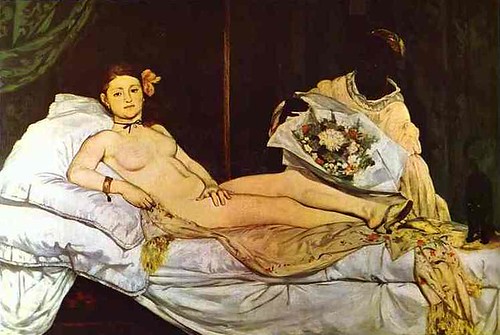
Today I rejected a comment on the entry Background Color for its sneering hostility. In short, the author of the comment called us stupid, too preoccupied with Gucci (as if) to know anything about art (which fashion, the author asserted firmly, was not). Furthermore, she scolded, we should "educate" ourselves so we might better recognize the "brilliance" of the NYLON editorial as an art historical reference to such canonical images like Edouard Manet's Olympia (1863) (Fig. 1) and not a comment on racial thinking or class inequities at all.


Fig. 1

First, let me mention that I will reject comments that are insulting or poorly composed. (Phrases strung together in a jumble connected with ellipses are not fun to read.) Second, the author of the rejected comment does point out something worth noting -- yes, the editorial certainly does reference a canonical theme in European art history, and no, this hardly excuses the editorial. If anything, it makes the editorial that much more a poignant example of the long duration of racisms and their entanglements with other vectors of power, including gender, sexuality, empire and labor. That is, what this comparison makes too obvious is that colonial and imperial histories of conquest and aesthetics continue to exert themselves in the present.


Fig. 2

In an essay called Slavery is a Woman, art historian James Smalls writes of this genre: "A recognized example of the standard representation of blacks in European art is provided by Jean-Marc Nattier's 1733 Mademoiselle de Clermont at Her Bath Attended by Slaves. (Fig. 2) There, black women are shown in their expected roles as servants and exoticized complements to the white mistress. [...] The portrait constitutes a visual record of white woman's construction and affirmation of self through the racial and cultural Other. [...] The black woman's headwrap and partial nudity are signs that mark her as different from white womanhood. As well, they constitute visible markers of white woman's command over black woman's labor." (The whole essay -- a meditation on visual representations of black women in 19th century European portraiture-- is well worth a look.)

And in an American Literature essay about an African American experimentalist poet, Deborah Mix speaks about these hauntingly familiar images too (to contextualize one of Harryette Mullen's poems, "A Petticoat"):

Questions of power—to speak, to create, to relax—are further interrogated by the fact that one woman lounges while another hovers inattendance. [...] In signifying on ‘‘A Petticoat , ’’ Mullen evokes Édouard Manet’s painting Olympia, whose nude, reclining white woman gazes directly at the viewer, while a black woman in a shapeless pink dress hovers in the background. Feminist art historians have read Manet’s painting as representing transgressive female sexuality, its female nude bold enough not only to revel in her nudity but also to stare directly at her would-be voyeurs. But this boldness appears to be available only to the upper- class white woman; the black servant nearly disappears into the shadows, holding flowers that may be a lover’s gift to Olympia. The servant’s sexuality, even her identity, appears to be subordinated to her mistress’s sexual power and to the power of the gaze. (Both Olympia and her viewers are free to look brazenly, but the black woman is not.) In fact, the black woman’s ill-fitting dress may have been a gift from her mistress, an exchange in which white femininity is thrust upon a black woman as both condescending generosity and an assertion of authority. Yet the dress, and the attitudes about gender and racial identity for which it is synecdoche, fails to fit. Furthermore, as the white woman luxuriates in the "rosy charms" of her pink nudity, the dark-skinned maid "wears [the white woman’s] color." Still cloaked in traditional "pink and white," the servant apparently exists to complement the privilege of Olympia’s femininity and sexuality. Olympia and her couch are painted on top of the murky background of heavy draperies and, of course, her servant, whose presence is highlighted primarily through the dress she wears rather than through her own body. In interpreting Mullen’s insertion of the Manet painting into her re-vision of [Gertrude] Stein’s poem, we confront the ways in which Stein, like "Olympia," enjoyed privileges conferred by her class and race. Stein’s boldness as a writer was enabled by wealth and leisure; those who enabled that leisure, such as domestic workers, are rendered nearly invisible.

The conditions of possibility for what the NYLON editorial looks like today are deeply embedded in the now-blunt nature of these earlier images. It might be a project for another time to attend to what has and has not changed about these aesthetic formations, their structures of knowledge production (especially of racial thinking), and unexpected entailments, but for now, I think it's clear that the aesthetic conventions of the NYLON editorial are both jarringly new and disturbingly the same.

28 July 2008

Background Color, Redux

I've been pleasantly buoyed by the great responses to my original entry on the Beth Ditto NYLON editorial. Today it's being republished on Racialicious, but meanwhile Fatshionista and other blogs belonging to fashionable and fabulous people have also penned some thoughtful responses. Here's a sample of some!

Over at Ballad of a Ladyman, Chrisomatic (who would hate to know that I wear high-waisted and wide-legged jeans like a second skin) had this to say: "It feels like a rehash of the Riot Grrrl movement where white, class privileged, activist women focussed largely on their own oppression while exhibiting racist, classist attitudes towards women of color and working class/poor women who sought to participate in a supposedly inclusive movement. I know she probably doesn't have 100% control over the editorial direction of a magazine photo shoot but she certainly has the power to say 'NO' in the same loudmouth way she speaks out against sizeist beauty standards, sexism and homophobia. "

Make Fetch Happen also linked the entry, and a commentator notes, "I have browsed through a hipster/alternative fashion magazine or two before and they always made me feel discomfort because they always seemed to be even more racist than people believe Vogue magazine to be." The subject of hipster racism in fashion, which is qualified as such because it is accompanied so often by a posture of irony that imagines that hipster + racism is incompatible or emptied out of historical depth, is totally fascinating and worth a closer look for sure.

And Matta Baby contrasts this editorial with other forms of "colonial chic:" "I find the offhandedness of the image heighten how disturbing it is to me, as if it's suggesting that this is the natural order. As comically obscene as something such as, say a Free People catalog is, at least they bother to appropriate their culture in the spread, at least it’s of some kind of twisted interest. Instead, here we are only offered the perpetual bleak sterility of working class life when you weren’t blessed with the natural sparkle of a complexion that stepped straight from the decks of the Mayflower."

And finally, at Fatshionista, Tara springboards off the entry I wrote to address the fat activism communities about intersectional analyses: "This tension plays out when someone who reveres Beth Ditto reads this article or sees this photo and immediately becomes defensive of her actions. My guess is that they feel betrayed and sad and maybe even desperate because all of a sudden, one of their icons has fucked up. And because there is such a dearth of fat cultural icons, they cling, because holding that person accountable for their choices probably means that they should reconsider their support of that artist/actor/performer/etc. And I venture this guess because I can imagine exactly how *I* would feel if one of my icons did something that betrayed my values....What does walking the talk of intersectionality look like? Is it 'ok' to give fat media icons a little more leeway because there are so few of them? Is the willingness to lower the bar proof that the FA movement isn’t taking race and the racism in our community seriously? How do we hold a media icon accountable for their actions when we can’t always engage or interact with them?"

Of course, there's also been the usual dismissive "people are too PC" and "it's fashion, it's not supposed to be real or meaningful!" too. These arguments miss the point that fantasy is just as powerful as reality in shaping our experiences of the world. See the entire histories of Africa as the savage "dark continent" or of Orientalisms, which are fantasies about "the other" that had tremendous impact on how lives and lands were transformed irrevocably.

Other thoughts -- the perception of Ditto's styling as "Oriental-y" seems to be a historical piece of the New Wave/No Wave aesthetic, spanning both its mainstream and underground incarnations to incorporate exoticism into its imagination. (Hi, David Bowie's "China Girl," Murray Head's "One Night in Bangkok," the Vapors' "Turning Japanese," et cetera.) Also, I'm glad someone could tell by her cards that Ditto's hand is a winning one. It certainly adds another detail to the photograph's dimensions.

25 July 2008

The World Domination of Young Asian Women

Just finished listening to Thom Wong’s inaugural podcast from his fashion blog, The Sunday Best. The podcast would be ideal listening for short airplane trips so I hope he continues to cast, and regularly!

His interview with Lulu Chang of Chictopia and everybody is ugly covered a lot of ground. Here are just some of his questions:

1. How did Chictopia get started?

2. What did she think was the future of the magazine publishing industry in the internet age?

3. What did she think of all personal style blogs that everyone seems to have or contribute to?

4. Why are so many fashion bloggers, young Asian women (yAw)?


Clearly, the last question has a particular "text-to-self" quality about it. But even before threadbared was conceived or launched, I noticed that yAw all over the world were posting about fashion, style, and other related topics. BUT WHY? Lulu suggested that the phenomenon of yAw’s world domination in the fashion blogosphere can be traced back on the one hand, to our essential Asian fierceness and, on the other hand, to the creepy fetishes that persist about us.

Following on Lulu’s musings are some of my own as well as some interesting figures that may help to contextualize the phenomenon (admittedly, the first two are really points of clarification):

  • Asian women across the age spectrum have always been a part of the fashion world—though not necessarily a visible part of it. Even so, their invisible (and oftentimes sweated) labor along with the labors of Latinas is the backbone of European, U.S., and Asian fashion production.
  • Are yAw blogging more about fashion or style? I know these topics converge and overlap but I wonder if they tend towards street-style type blogs that are photo-centric or blogs that are textual musings about everything fashion?
  • In either case, an issue to consider in understanding this phenomenon of the yAw fashion blogger has not as much to do with race than we think and more to do with their socioeconomic status. Not to get too Marxist—but access to internet technology, high-speed internet, the cultivation of cyber-skills, and the available time and energy you have to post has almost everything to do with which household gross income box you check on your tax form! That, and your geographic location.
  • According to the 2007 Census Bureau, only 51% of in the U.S. homes have broadband access and the largest portion of these homes (69%) is Asian American, followed by White (55%); African American (36%); Latino (35%); and American Indian (30%). In the Census’ infinite progressive wisdom, there is no data on mixed-raced households.
  • Not surprisingly, the data also shows that high-speed internet access is directly proportional to household annual income.
  • More surprisingly, though, is the Organisation for Economic Cooperation and Development’s findings that “despite America’s readiness and willingness to make use of advanced communications technologies, we are falling behind the rest of the world. In 2001, America stood near the top of global rankings of broadband adoption; a few short years later, we have been leapfrogged by our European and Asian competitors.” Also, “we are doing even worse when it comes to price and speed. The average broadband offering in Japan is 10 times faster than the average service available to U.S. consumers—at half of the cost.” By the way, the top three broadband nations are not in Asia but in Western Europe and Scandinavia: Denmark, Netherlands, and Iceland.
  • And finally, cyber-psychology researcher Eric B. Weiser argues that “Increasingly, internet users are now gradually becoming evenly divided among gender lines, and some estimate that women will eventually surpass men in Internet use in the next several years. In addition, findings suggest that interpersonal communication constitutes the dominant motive of female Internet use.”
Whatever the reasons are for yAw's fashion/style blog world dominance, our online presence in the fashion/style blog world sure beats our other vastly more dominant online presence as mail-order brides, sex workers, and domestics. A Google search for "young Asian woman" or "young [choose your favorite Asian ethnicity] woman" will return sites for yAw services, not our sartorial expertise. As Lulu suggested in her interview and as feminist scholars Vernadette V. Gonzalez and Robyn Magalit Rodriguez argue in "Filipina.com: Wives, Workers, and Whores on the Cyberfrontier," the internet may be a repository of democratized information and knowledge but it's still shaped by racially gendered systems of political and economic power.

The phenomenon of yAw fashion/style bloggers is important if only because it provides an alternative and authoritative online presence of yAw that is (mostly) of their own making.

Listen for Thom's forthcoming podcast interview with Susie Bubble - also, a yAw fashion blogger!