Showing posts with label labor. Show all posts

28 January 2010

Why I feel guilty when I don't blog

There are buckets of reasons why I'm glad Mimi is my on/offline writing collaborator and dear friend - but surely top among them is her capacity to deliver much-needed kick-in-the-ass motivation from thousands of miles away. At least that was the effect of her two previous blog posts for me this morning.

I've had a bit of blogger's block lately -- but it isn't for a lack of topics to write about. For example, I've been following the news and campaigns about fashion philanthropy (specifically, the Fashion Delivers campaign for Haiti and the LA Times' piece on Dress for Success) and wondering how much the overstatements about fashion's capacity to "empower" and "save," while no doubt commensurate with the prevailing lifestyle politics of neoliberalism in which consumer power is made co-extensive with political power, is also a kind of false bravado that betrays fashion's own inferiority complex about its social significance.

Add to that, Angela McRobbie's admonition (also bouncing around in my head lately) that fashion "colludes in its own trivialization." Here's the full quote from the essay, "Fashion Culture: Creative Work, Female Individualization":
In the absence of a lobby of policy-makers arguing vociferously on behalf of this autonomous sector, and for them to have access to low-rent urban retail spaces such as market stalls, lanes, corridors, and other cheap locations, when designers do find themselves in difficulty they are judged by a model which deems them simply unviable and the fashion press fatalistically announces another fashion label going out of business. Despite the profusion of fashion magazines, the expansion of the fashion media including television, and the appearance of academic journals devoted to fashion, there seems to be no coherent map of the field, which in turn encourages government to rely on simplistic accounts. In this sense, fashion lets itself down and colludes in its own trivialization.
In 2002 when McRobbie wrote "Fashion Culture," fashion bloggers weren't nearly as visible as they are today, so she didn't mention them or any other members of the "creative proletariat," like online and print magazine editors who finance their own publications. But like independent fashion designers, many bloggers and editors are being edged out by the corporatization of the cultural economy as well. It is increasingly difficult -- almost untenable -- for independent designers, bloggers, and editors to sustain their cultural projects without some form of material or immaterial corporate sponsorship (i.e., a feature story in a giant media outlet like the New York Times, affiliate marketing, direct ad sales, banner advertising, etc.). All of the social media outreach events planned for the upcoming Fall 2010 New York Fashion Week which, as Mimi puts it, are "aimed at cultivating new contacts and nurturing existing collaborations between fashion bloggers and captains of industry" attest to this.

Fashion and style bloggers understand that the support (material and immaterial) of fashion giants like the Chanel company, Marc Jacobs, or Vogue brings with it an enormous amount of cultural capital that can launch them into the stratosphere of fashion/media. And I certainly don't begrudge the fashion blog elite the corporate love they've received -- we've considered and continue to consider different strategies of monetization like speaking gigs, consulting, and commissioned articles. (Though we're not opposed to advertising, the opportunities we've been presented with haven't been right for us yet.)

Fashion bloggers and social media discourse celebrate -- quite automatically now -- the independent, DIY, and democratic spirit of blogging. Consider this quote about blogging from Jennine Tamm Jacob (The Coveted) in the video Mimi re-posted:
It was something that I could do. I could just set up a blog myself and I could write about whatever I wanted . . . it was just me doing my own thing and I found that to be really liberating.
But in understanding the cultural and political economies of the fashion blogosphere, it's important not to gloss over the fact that computer-mediated communication technologies and digital labor are deeply embedded in capitalist logics.

My 3-part blog post on the state of the fashion blogosphere has had many iterations -- a pocket-sized and abbreviated version appears in Style Sample Magazine, issue 5, and there's a revised and expanded academic essay I've been working on as well. In the expanded essay, I point out that the new digital work order in which fashion bloggers labor is shaped and limited by capitalist logics. For example, the structures of digital temporality (i.e., timestamps, the organization and archiving of posts in reverse chronological order, etc.) continue to naturalize and positively secure capitalist valuations of productivity, punctuality, and accumulation (of symbolic, cultural, and material capital). Working overtime (if we can still use that concept in the "flexitime" of digital temporality) is de rigeur for fashion bloggers, especially because their productivity must keep pace with the accelerated rhythms of the fashion-beauty complex organized and driven by the capitalist logic of the New/Now. In other words, the spirit of capitalism and its ethic of dogged and steadfast productivity permeate the digital creative labor of fashion blogs even when that labor is "free" (that is, both free from the 9-to-5 workday/workplace and also unpaid).

So while digital technoculture scholars and fashion bloggers alike celebrate the Internet for enabling the flexibility of work and work hours, it may be that we no longer need the external regulatory mechanisms of the Industrial Age (i.e., factory clocks, etc.) because in the Digital Age, we are self-monitoring and highly multi-tasking subjects whose body, image, and time -- commodified as cultural goods -- are produced, distributed, and consumed in a global cultural economy that is unprecedented in its pace and efficiency.

It's little wonder, then, why I've been feeling guilty about not posting! And I'm hardly alone -- consider how many and how often bloggers apologize for their lapses in posting. Such guilt illustrates the affective economies of digital capitalism as well!

As a salve for this capitalist guilt, I have to remind myself that I've been highly productive offline -- writing chapters at a maddening pace (for me) and loving (most) every minute of it. All free creative labor, but nevertheless . . .

I have to admit, though, it hasn't been all work for me. I've also been quite distracted and all dreamy about Julie Wilkins' London-based label, Future Classics, which I've only just discovered! (How did I not know about their deconstructed jersey deliciousness and their diaphanous silken wonders until now??) Now, should they want to collaborate on some affiliate marketing . . .

20 January 2010

LINKAGE: Healthy Nails, Ethical Fashion


Beauty is so often classified as a health concern --consider the layout of drugstore aisles, after all-- but just as often there is little to no awareness of unhealthy conditions for the industry's laborers. That's where the California Healthy Nail Salon Collaborative breaks new ground. Literally a collaboration between nail salon workers and owners, non-profit and community organizations focused on labor and environmental and reproductive health and justice, the Collaborative "uses policy advocacy, research, industry advocacy outreach, and education strategies to address health and safety concerns facing these communities [nail salon workers and owners, cosmetologists and their clients]. Our mission is to advance a preventative environmental health agenda for the nail salon sector in California."

The Collaborative offers loads of information about their campaigns for environmental and labor justice. Here's more about the health and safety risks for the beauty industry's labor forces, who are mostly women of color:

In California and throughout the United States, the beauty industry is booming. “Mani and pedis” are all the rage as customers want to be pampered with the latest nail designs, colors, and styles. Over the last twenty years, nail salon services have tripled and cosmetology is now the fastest growing profession in California.

Currently there are approximately 115,000 nail salon technicians in California, and most are women of color. Of these women, 59-80% are estimated to be Vietnamese immigrants, and more than 50% are of childbearing age. Many nail salon workers can earn less than $18,200 a year and work in conditions that can be hazardous to their health.

On a daily basis, nail salon workers handle numerous solvents, glues, and other nail care products. These contain many chemicals known to and suspected of causing acute and chronic illnesses including cancer, respiratory problems, skin problems and reproductive harm. There is very little state and federal government regulation of the chemicals used in these products. Also, little research has been done on the health issues that nail salon workers experience from long-term exposure to these chemicals. In fact, there are over 10,000 chemicals used in personal care and nail products and yet 89% have not been tested independently for their impacts on human health. Nail salon workers and other cosmetologists are at greater risk for health issues related to their work because of various challenges such as language and cultural barriers, and lack of access to health care. In addition, there is not enough culturally and linguistically appropriate education and outreach to this diverse population.

Through the California Healthy Nail Salon Collaborative, advocates are working together at the intersection of workers rights, women’s rights, environmental and reproductive health/justice, and Asian American community health to advance greater worker health and safety for this sector.


And I only recently stumbled across Fashioning an Ethical Industry (FEI), a UK-based education project of garment workers' rights organization Labour Behind the Label targeting the "next generation" of the fashion industry: "The project works with tutors and students of fashion-related courses to give an overview of how the fashion industry positively and negatively impacts on working conditions in garment manufacture and to inspire students - as the next generation of industry players - to raise standards in the for garment workers in the fashion industry of the future. We run students workshops, organise tutor training events, provide teaching resources and work with tutors to integrate ethical issues related to garment manufacture into their teaching." What makes FEI even better is the amazingly extensive teaching resources available on their site -- books, films, reports, factsheets, exhibitions, and more. I'll definitely make use of this site the next time I teach Politics of Fashion.

23 November 2009

FILM: Schmatta: Rags to Riches to Rags (HBO)

Set your DVRs for tomorrow morning when HBO will be showing a new film on the rise and fall of the New York City garment industry called, Schmatta: Rags to Riches to Rags. From HBO's description:

For generations of New Yorkers, the Garment District was the lifeblood of the city. But with the increased globalization of clothing manufacturing, this once-thriving area continues to shrink. This documentary looks at the vibrant, unexpected history of the Garment District and features interviews with workers, labor organizers, designers and fashion executives who look back at their careers in an area that was a doorway to the American Dream for thousands of immigrants. These stories provide an intimate portrait of an industry in decline--and give a timely look at how American manufacturing has changed, perhaps forever.

If you miss it on Tuesday, November 24, you can find it on HBO On Demand through December 6, 2009.

29 October 2009

PICTURING POLITICS: On "Pride In His Work"

This past Monday, in what brings nothing less than Driving Miss Daisy most prominently to mind, the Sartorialist posted a photograph from his book tour, featuring his (unnamed) driver in San Francisco. In his commentary, the Sartorialist remarks: "As you can see he was very elegant and practically oozed self-confidence, dignity and pride in his work. I love people who show pride in their work, regardless of the job."

Seemingly unaware that service workers labor under constant public scrutiny, he continues: "This man's car was spotless, his shoes were shined and he knew exactly where he was going. He wasn't dressed like that for me, he had no idea who I was, this was just another day and just another ride done in his own stylish way."

My first reaction was, What the fuck.

I've written about this before with regard to the Sartorialist's photograph of a presumably (but not assuredly) homeless black man and the commentary in which he imputes a quality of dignity to the man on the evidence of his well-matched accessories. This quality reappears here in the suit and smile, now matched with "pride in his work." Those structures of privilege or social realities that might mediate the encounter are nowhere accounted for. Instead, we are presented with what appears to be the snapshot of an individual who has risen above those unnamed social structures (only apparent in the condescension of "regardless of the job") to attain self-confidence and dignity, but who (in this story the Sartorialist tells) does not challenge those structures at all.

I want to quote again the brilliant Lauren Berlant on the icky sentimentalism of such regard:

The humanization strategies of sentimentality always traffic in cliché, the reproduction of a person as a thing, and thus indulge in the confirmation of the marginal subject’s embodiment of inhumanity on the way to providing the privileged with heroic occasions of recognition, rescue, and inclusion.
As before, the Sartorialist's rhetoric is the affective symptom of this world-view that first expresses amazement at the other's dignity ("he wasn't dressed like that for me"/"he is communicating his sense of pride and self-worth") and second expresses self-satisfaction at his own willingness to recognize that dignity -- without ever confronting the conditions or ideologies that enable such assumptions as its absence in the first place.

The comments perform this same economy of affirmation and forgetting -- this is the conditional affirmation of the other's dignity in so far as he appears to be "like us," and this is the selective forgetting of the histories of labor and race that continue to exclude the other from the measure of humanity. Especially here, because conceptions of labor are always interpolated with considerations of race, gender, sexuality, and nation, the figure of the black driver signifies in all these at once.

That is, in the following comments we see certain conceptions of contracted and service labor as they intersect with forms of racism and racialization (about black masculinity through prisms of racialized threat and its "domestication" in particular), material privileges and class comfort (consider the remarks about "trust" and "politeness"), and rules of gender stylization:


I immediately thought of Marshall (Ossie Davis) the limo driver in Joe vs the Volcano. Very nice.

He looks clean, and he looks proud of his job!

Pure style indeed. Could you post his contact information? I am in the Bay Area every few months and would like to book him.

VERY well put. everyone should take such pride in their jobs, regardless of the profession.

What a nice-looking man! You're right; taking care in one's appearance definitely inspires confidence. I'd definitely trust him to drive me anywhere.

Echoed repeatedly is the notion that "pride in one's work" is an important but increasingly rare quality. (This leads many commentators to wax nostalgic for an idealized image of the past, which carries its own historical racial connotations.) But what sort of attitude is this about those forms of labor that are comprised of economic vulnerability and racial exploitation? To emphasize, indeed to belabor, "pride in his work" as such is thus merely to raise a rather conventional attitude about the other's compliance with capitalism's often violent inequities.

That is, when does "pride in his work" slide seamlessly into "knows his place"? Such comments as "I would like to book him," "He looks proud of his job," express pleasure at what is presented as the scene of a black man proud to be at the service of others.

Thus the violence of historical servitude disappears, and it occurs to only a very few in his audience (of the commentators) that perhaps this performance is less pride and more prudence. In an uncertain economy, an individual employed in the service sector --especially as a driver or some other position requiring also affective labor (e.g., smiling, nodding, chuckling at terrible jokes)-- must perform satisfaction with their position in order to ensure their continued employment.

Showing this post to my students, many of them understood this immediately: that doing service work is a careful negotiation of bodily and sartorial performativity informed by race, gender, sexuality, and nation, under unequal conditions of labor and capital.

Meanwhile, I want to believe that this comment is the work of a minion at The Onion, because the final bit about his teeth seems so ludicrous it must be satire lampooning the racism of above-mentioned observations about the driver's cleanliness
: "Well put, Sart! Regardless of one's job, even if it's just to drive people around, one should always look nice, as this gentleman certainly does. We can't see his shoes, so we'll have to take your word that they are shined, but we can see his teeth, and they are well brushed indeed, further proof of his self-esteem."

A few comments do protest ("The fact that he is a driver doesn't mean he has a personal sound track which consists of 'It's a Hard-Knock Life'......"), and Stephanie writes at length:

You write all of this as though the fact that someone with a lower-class service job actually cares about themselves and has self-confidence and "dignity" is remarkable. He might not have been dressed like this specifically for you, but who knows why he dresses like this...could very well have something to do with wanting to get ahead in a service industry. As a friend of mine said,

"Additionally, the post, especially in remarks to politeness and "self-worth" makes me think of Richard Wright's novels, and specifically of Bigger Thomas in "Native Son," or of generations of black porters who learned to smile at every white person, or of cooks, drivers, and other employment groups of subservient Negroes that have faded into cultural memory."

Not that there is anything wrong with that on his part, just that I feel like you are romanticizing/aestheticizing away a lot of the more gruesome aspects of class, labor, and race in America. Which is potentially dangerous, and not in a good way. (Or, at least not in a good way for those of us who care about changing those conditions for the better.)
While allowing other comments --notably, the more obviously fucked-up ones expressing surprise and pleasure at the driver's cleanliness-- go unremarked, the Sartorialist did respond to Stephanie with a few disproportionate sentiments, including: "The problem is not me ....it's you! you try to scare people with your hyper-political correctness so everyone is scared to say anything.... Next time read what i wrote and not what you think you can twist around to fit your daily pc rant." (Oh, cliche*!) After Stephanie gently pointed out that she was just one comment among many --most of which are uniformly fawning-- and had no actual power to censor anyone on his blog, the Sartorialist apologized, sort of ("we were too harsh on each other").


* From this post: "Underlying every complaint of 'PC' is the absurd notion that members of dominant mainstream society have been victimized by an arbitrarily hypersensitive prohibition against linguistic and cultural constructions that are considered historical manifestations of bigotry." And furthermore, from Racialicious: "Berg explains that in its original context, PC was a pejorative term used by people who felt they were losing something. Exactly what they were losing is very hard to describe, especially to them. But many sociologists and historians today have come to a consensus on what they call it: it’s a loss of privilege—and in terms of race, a loss of white privilege."

03 August 2009

Hands On Theory

Fashion is a craft, not an industrial, conception, exemplifying to perfection the labor theory of value. The toil of many hands is the sine qua non of fashion. The hand of the weaver, the cutter, the fitter, the needleworker must be seen in the finished product in a hundred little details, and fashion knowledge, professionally, consists in the recognition and appreciation of the work that has gone into a costume. In gores and gussets and seams, in the polish of leather and its softness, the signature of painstaking labor must be legible to the discerning, or the woman is not fashionably dressed. The hand-knit sweater is superior to the machine-knit, not because it is more perfect, but on the contrary because its slight imperfections reveal it to be hand-knit. The Oriental pearl is preferred to the fine cultured pearl because the marine labor of a dark diver secured it, a prize wrested from the depths, and the woman who wears Oriental pearls believes that they show variations in temperature or that they change color with her skin or get sick when they are put away in the safe. In short, that they are alive, whereas cultured pearls, mass-stimulated in mass beds of oysters, are not. This sense of the accrued labor of others as a complement to one's personality, as tribute in a double sense, is intrinsic to the fashionable imagination, which desires to feel that labor next to its skin, in the hidden stitching of its underwear. Hence the passion for handmade lingerie even among women whose outer clothing comes off the budget rack.

-- Mary McCarthy, "Up the Ladder from Charm to Vogue," July-August 1950, from On the Contrary: Articles of Belief, 1946-1961

31 July 2008

Background Color, Redux II

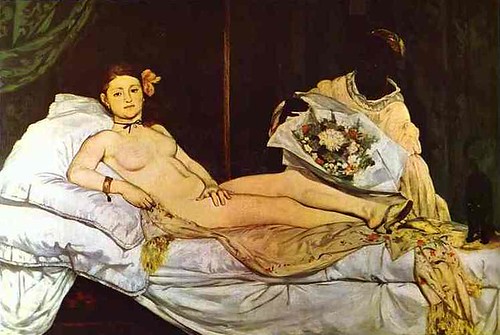
Today I rejected a comment on the entry Background Color for its sneering hostility. In short, the author of the comment called us stupid, too preoccupied with Gucci (as if) to know anything about art (which fashion, the author asserted firmly, was not). Furthermore, she scolded, we should "educate" ourselves so we might better recognize the "brilliance" of the NYLON editorial as an art historical reference to such canonical images like Edouard Manet's Olympia (1863) (Fig. 1) and not a comment on racial thinking or class inequities at all.


Fig. 1

First, let me mention that I will reject comments that are insulting or poorly composed. (Phrases strung together in a jumble connected with ellipses are not fun to read.) Second, the author of the rejected comment does point out something worth noting -- yes, the editorial certainly does reference a canonical theme in European art history, and no, this hardly excuses the editorial. If anything, it makes the editorial that much more a poignant example of the long duration of racisms and their entanglements with other vectors of power, including gender, sexuality, empire and labor. That is, what this comparison makes too obvious is that colonial and imperial histories of conquest and aesthetics continue to exert themselves in the present.


Fig. 2

In an essay called Slavery is a Woman, art historian James Smalls writes of this genre: "A recognized example of the standard representation of blacks in European art is provided by Jean-Marc Nattier's 1733 Mademoiselle de Clermont at Her Bath Attended by Slaves. (Fig. 2) There, black women are shown in their expected roles as servants and exoticized complements to the white mistress. [...] The portrait constitutes a visual record of white woman's construction and affirmation of self through the racial and cultural Other. [...] The black woman's headwrap and partial nudity are signs that mark her as different from white womanhood. As well, they constitute visible markers of white woman's command over black woman's labor." (The whole essay -- a meditation on visual representations of black women in 19th century European portraiture-- is well worth a look.)

And in an American Literature essay about an African American experimentalist poet, Deborah Mix speaks about these hauntingly familiar images too (to contextualize one of Harryette Mullen's poems, "A Petticoat"):

Questions of power—to speak, to create, to relax—are further interrogated by the fact that one woman lounges while another hovers inattendance. [...] In signifying on ‘‘A Petticoat , ’’ Mullen evokes Édouard Manet’s painting Olympia, whose nude, reclining white woman gazes directly at the viewer, while a black woman in a shapeless pink dress hovers in the background. Feminist art historians have read Manet’s painting as representing transgressive female sexuality, its female nude bold enough not only to revel in her nudity but also to stare directly at her would-be voyeurs. But this boldness appears to be available only to the upper- class white woman; the black servant nearly disappears into the shadows, holding flowers that may be a lover’s gift to Olympia. The servant’s sexuality, even her identity, appears to be subordinated to her mistress’s sexual power and to the power of the gaze. (Both Olympia and her viewers are free to look brazenly, but the black woman is not.) In fact, the black woman’s ill-fitting dress may have been a gift from her mistress, an exchange in which white femininity is thrust upon a black woman as both condescending generosity and an assertion of authority. Yet the dress, and the attitudes about gender and racial identity for which it is synecdoche, fails to fit. Furthermore, as the white woman luxuriates in the "rosy charms" of her pink nudity, the dark-skinned maid "wears [the white woman’s] color." Still cloaked in traditional "pink and white," the servant apparently exists to complement the privilege of Olympia’s femininity and sexuality. Olympia and her couch are painted on top of the murky background of heavy draperies and, of course, her servant, whose presence is highlighted primarily through the dress she wears rather than through her own body. In interpreting Mullen’s insertion of the Manet painting into her re-vision of [Gertrude] Stein’s poem, we confront the ways in which Stein, like "Olympia," enjoyed privileges conferred by her class and race. Stein’s boldness as a writer was enabled by wealth and leisure; those who enabled that leisure, such as domestic workers, are rendered nearly invisible.

The conditions of possibility for what the NYLON editorial looks like today are deeply embedded in the now-blunt nature of these earlier images. It might be a project for another time to attend to what has and has not changed about these aesthetic formations, their structures of knowledge production (especially of racial thinking), and unexpected entailments, but for now, I think it's clear that the aesthetic conventions of the NYLON editorial are both jarringly new and disturbingly the same.

28 July 2008

Background Color, Redux

I've been pleasantly buoyed by the great responses to my original entry on the Beth Ditto NYLON editorial. Today it's being republished on Racialicious, but meanwhile Fatshionista and other blogs belonging to fashionable and fabulous people have also penned some thoughtful responses. Here's a sample of some!

Over at Ballad of a Ladyman, Chrisomatic (who would hate to know that I wear high-waisted and wide-legged jeans like a second skin) had this to say: "It feels like a rehash of the Riot Grrrl movement where white, class privileged, activist women focussed largely on their own oppression while exhibiting racist, classist attitudes towards women of color and working class/poor women who sought to participate in a supposedly inclusive movement. I know she probably doesn't have 100% control over the editorial direction of a magazine photo shoot but she certainly has the power to say 'NO' in the same loudmouth way she speaks out against sizeist beauty standards, sexism and homophobia. "

Make Fetch Happen also linked the entry, and a commentator notes, "I have browsed through a hipster/alternative fashion magazine or two before and they always made me feel discomfort because they always seemed to be even more racist than people believe Vogue magazine to be." The subject of hipster racism in fashion, which is qualified as such because it is accompanied so often by a posture of irony that imagines that hipster + racism is incompatible or emptied out of historical depth, is totally fascinating and worth a closer look for sure.

And Matta Baby contrasts this editorial with other forms of "colonial chic:" "I find the offhandedness of the image heighten how disturbing it is to me, as if it's suggesting that this is the natural order. As comically obscene as something such as, say a Free People catalog is, at least they bother to appropriate their culture in the spread, at least it’s of some kind of twisted interest. Instead, here we are only offered the perpetual bleak sterility of working class life when you weren’t blessed with the natural sparkle of a complexion that stepped straight from the decks of the Mayflower."

And finally, at Fatshionista, Tara springboards off the entry I wrote to address the fat activism communities about intersectional analyses: "This tension plays out when someone who reveres Beth Ditto reads this article or sees this photo and immediately becomes defensive of her actions. My guess is that they feel betrayed and sad and maybe even desperate because all of a sudden, one of their icons has fucked up. And because there is such a dearth of fat cultural icons, they cling, because holding that person accountable for their choices probably means that they should reconsider their support of that artist/actor/performer/etc. And I venture this guess because I can imagine exactly how *I* would feel if one of my icons did something that betrayed my values....What does walking the talk of intersectionality look like? Is it 'ok' to give fat media icons a little more leeway because there are so few of them? Is the willingness to lower the bar proof that the FA movement isn’t taking race and the racism in our community seriously? How do we hold a media icon accountable for their actions when we can’t always engage or interact with them?"

Of course, there's also been the usual dismissive "people are too PC" and "it's fashion, it's not supposed to be real or meaningful!" too. These arguments miss the point that fantasy is just as powerful as reality in shaping our experiences of the world. See the entire histories of Africa as the savage "dark continent" or of Orientalisms, which are fantasies about "the other" that had tremendous impact on how lives and lands were transformed irrevocably.

Other thoughts -- the perception of Ditto's styling as "Oriental-y" seems to be a historical piece of the New Wave/No Wave aesthetic, spanning both its mainstream and underground incarnations to incorporate exoticism into its imagination. (Hi, David Bowie's "China Girl," Murray Head's "One Night in Bangkok," the Vapors' "Turning Japanese," et cetera.) Also, I'm glad someone could tell by her cards that Ditto's hand is a winning one. It certainly adds another detail to the photograph's dimensions.

19 July 2008

Background Color


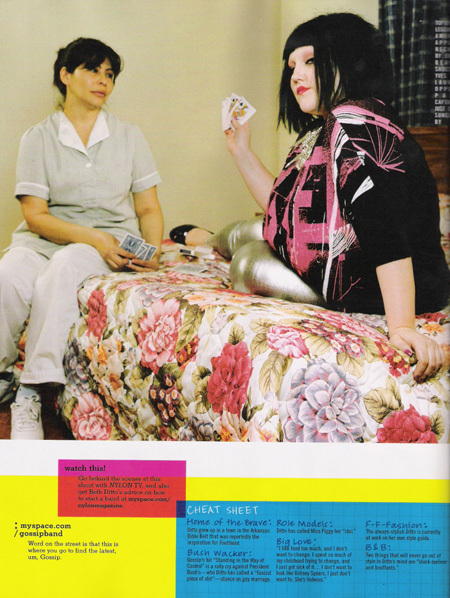
While the Gossip isn't in my regular rotation (there's always something about the production value of their albums that throws me), Beth Ditto's ascension as a fearlessly fat and femme style icon is on my radar for sure. There's much to be said about Beth Ditto, fat and fashion, but the above photograph from Ditto's eight-page editorial in NYLON's recent music issue is about none of these things for me.

It's about the woman who may or may not be a real housekeeper at the motel at which this editorial was photographed, sitting on the edge of the bed with a handful of cards and gazing at Ditto with a weary but guarded expression. In the story that coalesces for me, studying this photograph, she has just been forced to play cards with a guest -- not because she wants to, but because she could lose her job if she doesn't. Nor does the game even feel like a break from her domestic labor; this sort of affective labor is no less taxing. In her mind (in the story I imagine about this editorial), she calculates how much longer she'll have to stay and clean in order to meet her day's quota.

But none of this is supposed to be visible (or even viable) in the photograph. We are not meant to consider her story. (And I'm made uncomfortable by my own attempt to "give" her an interior life.) Instead, the woman of color in her drab housekeeper's uniform is simply another part of the furnishing in this bland motel room. She is banished as mere and muted background, the better to illuminate Ditto's extraordinary excess of shine and glamor. For that reason, this editorial photograph both angers and saddens me.

Much has been written about the uses of people of color as part of the landscape in fashion editorials. (See, for just a small sample, Make Fetch Happen's disgust for colonial chic, Racialicious' archive on fashion, or bell hooks' canonical essay "Eating the Other"). This cliché includes "exotic" locales and touristic images of the "natives," who wear clothes and other adornment that are imagined as traditional and time-bound. (In Viet Nam, a frequent setting, these might be so-called pajamas and conical hats; in the often-undifferentiated Africa, also a regular landscape, loincloths and face paint). The deliberate contrast between these figures (native and model) is arranged along a spectrum of race, but also time and space. The Vietnamese, the African, the Peruvian, are imagined to live at a temporal and geographic distance from the modern, and implicitly Western, woman who might wear these fashionable clothes. The compulsion to return to this scene, through which the natives in their deindividuating garb serve to highlight the cosmopolitanism, the expressive and unique sense of self, of the woman who wears (or at least covets) Prada, reveals much about the continuing investments of fashionable discourses to an inheritance of colonial regimes of power and knowledge. It is a fantasy, yes, but no less powerful for being so.

What is happening here is no less committed to this uneven distribution. The uniform deindividuates the housekeeper as much as a generic “native” costume might; she blends nearly seamlessly into the walls of the motel room, she clashes dully with the bedspread. We might even argue that the uniform in fact becomes the generic “native” costume; the racialization of this (also feminized) domestic labor in the hospitality industry has already been normalized, naturalized, to make this premise utterly reasonable. The housekeeper is meant to be invisible, working unobtrusively around the perceptual periphery of the guest, and this scene is no exception. She is part of the set dressing, in which Ditto’s bright and hard-edged New Wave styling intrudes to asserts itself as distinct, as foreground. This blandness, this generic and ordinary landscape, the photograph suggests, is not Ditto's natural habitat. By implication, it is the housekeeper's.

And although Ditto and the housekeeper more obviously inhabit the same historical moment, they do not exist in the same tempo. The housekeeper’s time is syncopated, regulated, by her repetitive labor; as imagined here, Ditto’s time, perhaps filled with boredom in search of novelty (like consorting with the housekeeper), stretches out at leisure. Here, the temporal distance is a matter of how each person experiences this small interval, this interlude of a card game.

Meanwhile Ditto addresses the camera with a sexy, sly look that feels intimate, insider-y. This sort of winking acknowledgment of the viewer is important to the style sensibility that NYLON cultivates as an "alternative" fashion magazine. The NYLON reader is interpellated as fashion-forward, “in the know,” someone who can “get” and appreciate the many cultural references to MisShapes, Cobrasnake, Cory Kennedy, Williamsburg, whatever. (And, it should be noted, the world of NYLON is glaringly white.) But it also reinforces the distance between the presumed viewer and the housekeeper who is not included in this wink, and who is not imagined to share this same base of knowledge. (It doesn't seem to matter whether Ditto's look is conspiratorial --"Isn't it fun to be fabulous?"-- or self-deprecating --"Isn't this fashionable life total bullshit?"-- because this insight is decidedly not shared with the housekeeper.) And, of course, as Foucault taught us, knowledge is inextricably caught up in power – and this one photograph encapsulates this bind, how even this “minor” event, the trivial detail of the housekeeper's uniform or Ditto’s look, might be complicit.

In a million ways, the housekeeper's inclusion in this image emphasizes, and even enacts, her exclusion. I would have enjoyed this editorial much, much more, had she not been made to appear in it for the purpose of disappearing her all the better.

EDIT: For updates and further thoughts, see Background Color, Redux and Background Color, Redux II.