Showing posts with label exhibit. Show all posts

18 August 2009

EXHIBIT: Dress Codes: Clothing as Metaphor


There's an interesting exhibit at the Katonah Museum of Art (NY) called Dress Codes: Clothing as Metaphor. From the website: "The 36 artists in Dress Codes use clothing to explore a variety of issues ranging from feminine concern, racial stereotyping, and immigration to globalization, current events, and the violence of war. Many of the works explore a number of these subjects concurrently, reflecting the complexity of contemporary life."

There's also a short article on the exhibit in the Huffington Post. According to Barbara Bloemik: "In a world in which airplanes become bombs, and birds carry deadly diseases across oceans, very little can be taken for granted. In this environment, the artists in Dress Codes understand the need to move beyond personal identities and temporal political concerns. By using clothing -- something we all choose every day -- as their medium, they share a collective interest in bringing a greater awareness of the issues that affect our planet into our everyday lives."

12 July 2009

EXHIBIT: Fashion & Politics


This is just straight lifted from the museum's description:

Fashion & Politics
July 7, 2009 – November 7, 2009

The Museum at FIT presents Fashion & Politics, a chronological exploration of over 200 years of politics as expressed through fashion. The term politics not only refers to the maneuverings of government, but also encompasses cultural change, sexual codes, and social progress. Throughout history, fashion has been a medium for conveying political ideologies and related social values. Fashion has addressed such important themes as nationalism, feminism and ethnic identity, as well as significant events and subcultural movements.

Featuring over one hundred costumes, textiles and accessories, Fashion & Politics examines the rich history of politics in fashion. The exhibition’s introductory gallery will explore the theme of American nationalism and will feature a woman’s costume, circa 1889, printed with an American flag motif, as well as Catherine Malandrino’s iconic Flag Dress, worn by numerous celebrities and socialites to express patriotism after 9/11, and then again in response to the 2008 elections. Also featured will be an "IKE" dress from the 1956 Eisenhower Campaign, a "NIXON" paper dress, and memorabilia from the historic 2008 presidential elections.

Image from the Museum at FIT: "American Flag" costume, USA, circa 1889, Printed cotton, Gift of Stephen de Pietri, 88.125.1

29 June 2009

EXHIBIT: Party Time with Yinka Shonibare


Lucky for those of you in Jersey! On July 1, the Newark Museum will present a major site-specific installation by the acclaimed British artist Yinka Shonibare MBE called Party Time: Re-Imagine America to commemorate the museum's centennial. From Allison McCartney for the Newark Museum:

For the Newark Museum commission, Shonibare chose as his setting the mahogany-paneled dining room of the Ballantine House, built in 1885 for the prominent Newark brewing family, Jeannette and John Holme Ballantine, and part of the Newark Museum's campus since 1937. In this opulent interior, the artist has staged an imagined scene of a late 19th century dinner party midway through a multi-course feast.

Eight headless figures, dressed in period costume made from the artist's signature "Dutch wax" fabric, are seated around an elaborately set table as a servant appears bearing the main course, a large peacock served on a silver platter. The animated body language of the guests suggests a moment in which proper Victorian etiquette has begun to disintegrate, as an indulgent celebration of prosperity tips towards misbehavior and even debauchery. The scene references the rise of wealth and quest for refinement that accompanied industrialization in the United States, where the elaborate dinner party replaced the bare-minimum meal, becoming a celebratory "eating fest" for the social and economic ruling class.

Party Time is one of the Shonibare's most important works to date, reflecting the culmination of major themes that the artist has explored in his work for over a decade," observes Christa Clarke, the curator of Party Time and the Museum's Curator of the Arts of Africa and Senior Curator of the Arts of Africa and the Americas. "At its core, the installation considers the discrepancies of wealth generated by late-nineteenth-century enterprise, in which the material excesses and self-indulgence of a privileged few were made possible by the labor of others. His references to the increasingly uneven distribution of wealth in late 19th century America seem particularly relevant at this moment in time in the wake of our current economic collapse as a result of out-of-control spending."


For those who are interested, on June 30, curator Christa Clarke will engage Shonibare in a dialogue about the artistic process in developing Party Time and how this major sculptural installation relates to his larger body of work. The 7 pm discussion will be preceded by a reception in the Museum's Engelhard Court beginning at 6 pm, during which you will be able to preview the installation. The event is free and pre-registration is required.

While best experienced in person -- it's difficult to otherwise replicate the sensation of being drawn into the sensuous richness of his bright fabrics, while being distracted by the headless mannequins' arrested gestures of promised violence-- his tableaus presenting the perversions of colonialism are gorgeous and disturbing in any medium. For additional reading and viewing of his works, check out a great overview of Shonibare's 2008 exhibition at the James Cohan Gallery (NYC) called The Age of Reason, as well as his 2005 interview with BOMB Magazine. You can also watch and/or listen to him talk about his work at the Tate in 2004, and hell, read this just-published essay about him at TIME.


From the installation Gallantry and Criminal Conversation, 2002

07 May 2009

Queer + Fashion


Some weeks ago, my brilliant sister-friend Iraya Robles (formerly of San Francisco's queercore outfit Sta-Prest) told me about a performance she wanted to put together about Tina Chow, the iconic mixed-race model and socialite who died in 1992 from AIDS-related complications. Iraya wants to bring Chow's couture collecting and connoisseurship to some of her own concerns about the psychological processes of collecting --picking and choosing, or even sometimes hoarding-- and how these might relate to outsider status. I can't do the project justice (and I should probably talk to her about it to be sure I got it right!), but it did send me on a quest to find some new sources of queer + fashion inspiration.

Now, I can enumerate academic sources at length, but what about the fashion blog-o-sphere?

Luckily, I just stumbled across What's Her Tights, a newish blog (that somehow manages to post much more often than ours!) dedicated to "Queer Fashion, Radical Politics." Hers is some serious whip-smartness, with posts about the gendering of our technologies (cell phones, et cetera); disappointing drag king performances; immigrants and the informal dress codes that signal assimilation or its absence (something Minh-ha and I have discussed in terms of the so-called, and somehow understood-as-self-evident, "fresh off the boat" aesthetic); how superstar MIA's clothing becomes "style" (instead of "trash") after her fame; and a really pointed set of questions about how charity clothing donation creates and circulate certain sorts of feelings (delight in another's reuse of an item that might also, and problematically, assume gratitude on the part of those "less fortunate") that need to be unpacked; and much, much more. I hope she doesn't mind that I want showcase a bit of her genius here with this excerpt from an entry about the hipster accessory, the cowboy boot:

There is so much I just don’t know about this country-singer-turned-ironic-hipster fashion footwear. The transformations in cowboy boot design—the array of pointed toes, evolution of steel inserts, and varied shaft height—are all masked and narrated (especially if you look up cowboy boots on wikipedia) as practical accommodations for horseback riding and improving riding maneuvers in general. But what pop sources won’t tell you is that these shifts in design also had to do with facilitating the larger project of white supremacy and coercion, in essence making it easier to injure “Indians” through physical combat. This footwear has roots in something so unmistakably violent (not only toward the animals of which they’re made)… a real piece of Americana. And that’s a fact. Or a hoax. There can only be two “choices” right?

Also, I totally get her little opening post about the Milwaukee mullet ("mom or lesbian, or maybe both?"). Shhhh, I'm hoping that we can be fashion blog friends!

For those of you in the Bay Area, the 2009 National Queer Arts Festival includes an exhibition called Threads, housed at SOMArts from June 7-26 (here's the information for the opening reception). There doesn't seem to be much information about the exhibition , but for this brief and somewhat vague blurb from the reception announcement:

Threads is not just about fabric and costume but also how queerness weaves the threads of our physical, social and moral existence together into a multi-dimensional fabric of community and our selves. What are the threads that bind, mend and sometimes unravel this spectacular fabric? How do we fashion, perform, subvert or display queerness in our art and lives?
I desperately wish I could be there for Laye(red), a performance by Thisway/Thatway (a.k.a. Stephanie Cooper), which explores the work of fashion in fundraising, and "conscientious" consumption as a human rights instrument, as practiced by the GAP (red) campaign. While focusing (it seems) on the "pop-cultural appropriation of blackness for profit," I'm hoping this performance also queries the idea of "Africa" circulating throughout such campaigns as a "dark continent," which is so incredibly critical for how we understand the place of "Africa" (and I put that in scare quotes on purpose) in global discourses of sex and development, disease vectors and health initiatives. I mean, "AIDS in Africa," both as an epidemiological crisis and as a humanitarian campaign, signifies certain colonial and imperial notions that require careful untangling.

The Gap (PRODUCT) RED campaign is a collaborative effort between celebrities, multilateral organizations, and Gap Inc. Half of the proceeds from signature items will become charitable contributions to "help eliminate AIDS in Africa." In this cultural moment where Gwyneth Paltrow declares, "I am African," and Bono advises we, "Shop 'til it stops," Laye(red) takes on this pop-cultural appropriation of blackness for profit.

I wonder if there'll be video of this performance? I feel I could teach this in at least two courses (Politics of Fashion and Transnational Feminist Studies)!
10 June 2008

STYLE ICON: Alice Bag

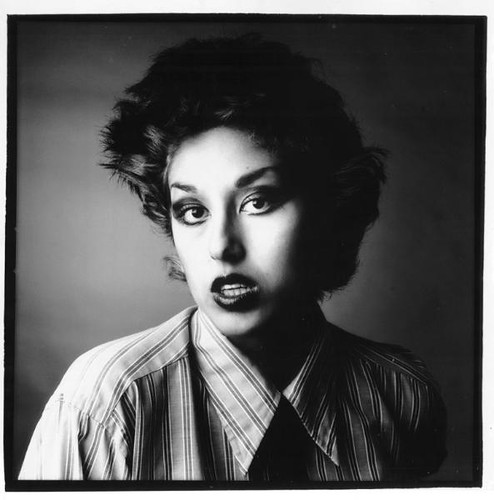
In 1977, Los Angelenos Alice Armandariz and Patricia Rainone formed The Bags, who went on to become an important (if brief-lived) fixture in the LA punk scene. What little footage I've seen of their live performances still sends shivers up my spine -- Alice is such an indomitable force in stiletto boots and torn t-shirts, blackened eyes and shock of hair (sometimes covered by a paper bag for the band's early performances), all sneer and prowl on stage. In still photographs, Alice is beautiful, tough, defiant and intense, whether she's wearing bondage pants or a '60s femme fatale black sheath dress. Women like Alice Bag were my style references for punk rock feminism when I was a suburban teenager dreaming of escape.

I bring her up because of the new exhibition Vexing: Female Voices from LA Punk at the Claremont Museum, at which Alice Bag performed for the exhibition's opening night gala. (Check out the Los Angeles Times article about the exhibition here.) Here's part of the exhibition's description:

The burgeoning punk rock music scene of the late 1970s and early 1980s in East Los Angeles provided an electrically charged, creative climate. This scene created an atmosphere where performance mixed with poetry, and visual culture was defined by an aesthetic and an attitude. Artists and musicians interfaced and blurred the lines of actions, documentation, photography, sound and style. Taking its name from the all-ages music club The Vex, once housed within East Los Angeles’ Self Help Graphics and Art, Vexing is an historical investigation of the women who were at the forefront of this movement of experimentation in music, art, culture and politics, while exploring their lasting legacies and contemporary practices. This documentary-style exhibition will include photo, video and audio archives of the era as well as studio work encompassing painting, installation, writings and performance.

I hope I can get to Los Angeles again (my girlfriend is a dedicated partisan to the early LA punk scene, and we somehow missed the exhibition when we were in town a few weeks ago) before the exhibition closes, but meanwhile, I'm inspired to try to incorporate Alice's amazing presence in the coming months. Check out the rest of her amazing photo gallery at her website. (And for the site --and posts-- that inspired this one, check out No Good For Me's own list of style icons.) (Mimi)