24 July 2008

Letter to the Editor


Checking Make Fetch Happen, I remembered that I also wanted to note that the latest issue of NYLON (featuring the totally tedious Mischa Barton on the cover) did contain one high note, a letter to the editor:

Dear Nylon,

Your ass history piece in the April issue is fucking laughable. You can give props to Applebottom Jeans all you want; the only ladies of color in the magazine were in the street fashion spread.

Olivia - Urbana, IL

Ha ha ha ha! And, as one of the commentators at Make Fetch Happen notes, "I think its pretty telling that they reference black culture as ironic, but ignore us in the pages." More on this observation at a later date, hopefully.

Academic Romper Room

This summer is about writing my book in intensive writing boot camp with friends who are similarly situated in their academic careers. Gradually, however, over the last six weeks, we have become lazier and lazier about getting dressed for our work day, which begins around 9 a.m. and ends with an hour of yoga at 4 p.m.. The Dolphin shorts, the workout skort, the yoga pants, the denim overalls, the four-day old t-shirt, have all made appearances among us. (These sartorial tragedies, however, don't keep us from debating the merits of Hayden-Harnett bags or cooing over one of our number's new specially ordered Victor Osborne hat. Though only in between out-loud ruminations about dance theory and whether or not to capitalize "orientalism," of course!) I'm pretty sure that I've rotated between three or four pairs of shorts over this time, but yesterday, at the mall with one of my writing boot camp cohort, I decided that what I really needed was a one-piece romper that would serve me during working hours and through our yoga sessions and the frequent grilling parties that follow -- and I decided that this striped romper from Forever 21 would do the trick. Now I can comfortably curl up in the dining room chair with my legs folded up between me and the table as I type (my denim and corduroy shorts got uncomfortable after a while), and I won't have to tuck my t-shirts into my shorts when I do handstands against the wall. I know it's wrong, but it feels sooo right. I think I could finish my book in this thing.

19 July 2008

Background Color


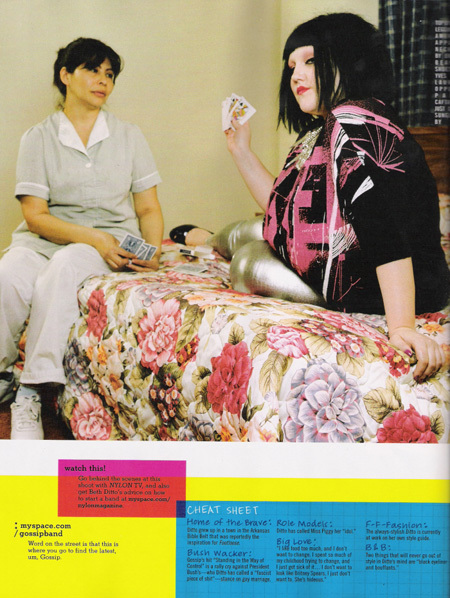
While the Gossip isn't in my regular rotation (there's always something about the production value of their albums that throws me), Beth Ditto's ascension as a fearlessly fat and femme style icon is on my radar for sure. There's much to be said about Beth Ditto, fat and fashion, but the above photograph from Ditto's eight-page editorial in NYLON's recent music issue is about none of these things for me.

It's about the woman who may or may not be a real housekeeper at the motel at which this editorial was photographed, sitting on the edge of the bed with a handful of cards and gazing at Ditto with a weary but guarded expression. In the story that coalesces for me, studying this photograph, she has just been forced to play cards with a guest -- not because she wants to, but because she could lose her job if she doesn't. Nor does the game even feel like a break from her domestic labor; this sort of affective labor is no less taxing. In her mind (in the story I imagine about this editorial), she calculates how much longer she'll have to stay and clean in order to meet her day's quota.

But none of this is supposed to be visible (or even viable) in the photograph. We are not meant to consider her story. (And I'm made uncomfortable by my own attempt to "give" her an interior life.) Instead, the woman of color in her drab housekeeper's uniform is simply another part of the furnishing in this bland motel room. She is banished as mere and muted background, the better to illuminate Ditto's extraordinary excess of shine and glamor. For that reason, this editorial photograph both angers and saddens me.

Much has been written about the uses of people of color as part of the landscape in fashion editorials. (See, for just a small sample, Make Fetch Happen's disgust for colonial chic, Racialicious' archive on fashion, or bell hooks' canonical essay "Eating the Other"). This cliché includes "exotic" locales and touristic images of the "natives," who wear clothes and other adornment that are imagined as traditional and time-bound. (In Viet Nam, a frequent setting, these might be so-called pajamas and conical hats; in the often-undifferentiated Africa, also a regular landscape, loincloths and face paint). The deliberate contrast between these figures (native and model) is arranged along a spectrum of race, but also time and space. The Vietnamese, the African, the Peruvian, are imagined to live at a temporal and geographic distance from the modern, and implicitly Western, woman who might wear these fashionable clothes. The compulsion to return to this scene, through which the natives in their deindividuating garb serve to highlight the cosmopolitanism, the expressive and unique sense of self, of the woman who wears (or at least covets) Prada, reveals much about the continuing investments of fashionable discourses to an inheritance of colonial regimes of power and knowledge. It is a fantasy, yes, but no less powerful for being so.

What is happening here is no less committed to this uneven distribution. The uniform deindividuates the housekeeper as much as a generic “native” costume might; she blends nearly seamlessly into the walls of the motel room, she clashes dully with the bedspread. We might even argue that the uniform in fact becomes the generic “native” costume; the racialization of this (also feminized) domestic labor in the hospitality industry has already been normalized, naturalized, to make this premise utterly reasonable. The housekeeper is meant to be invisible, working unobtrusively around the perceptual periphery of the guest, and this scene is no exception. She is part of the set dressing, in which Ditto’s bright and hard-edged New Wave styling intrudes to asserts itself as distinct, as foreground. This blandness, this generic and ordinary landscape, the photograph suggests, is not Ditto's natural habitat. By implication, it is the housekeeper's.

And although Ditto and the housekeeper more obviously inhabit the same historical moment, they do not exist in the same tempo. The housekeeper’s time is syncopated, regulated, by her repetitive labor; as imagined here, Ditto’s time, perhaps filled with boredom in search of novelty (like consorting with the housekeeper), stretches out at leisure. Here, the temporal distance is a matter of how each person experiences this small interval, this interlude of a card game.

Meanwhile Ditto addresses the camera with a sexy, sly look that feels intimate, insider-y. This sort of winking acknowledgment of the viewer is important to the style sensibility that NYLON cultivates as an "alternative" fashion magazine. The NYLON reader is interpellated as fashion-forward, “in the know,” someone who can “get” and appreciate the many cultural references to MisShapes, Cobrasnake, Cory Kennedy, Williamsburg, whatever. (And, it should be noted, the world of NYLON is glaringly white.) But it also reinforces the distance between the presumed viewer and the housekeeper who is not included in this wink, and who is not imagined to share this same base of knowledge. (It doesn't seem to matter whether Ditto's look is conspiratorial --"Isn't it fun to be fabulous?"-- or self-deprecating --"Isn't this fashionable life total bullshit?"-- because this insight is decidedly not shared with the housekeeper.) And, of course, as Foucault taught us, knowledge is inextricably caught up in power – and this one photograph encapsulates this bind, how even this “minor” event, the trivial detail of the housekeeper's uniform or Ditto’s look, might be complicit.

In a million ways, the housekeeper's inclusion in this image emphasizes, and even enacts, her exclusion. I would have enjoyed this editorial much, much more, had she not been made to appear in it for the purpose of disappearing her all the better.

EDIT: For updates and further thoughts, see Background Color, Redux and Background Color, Redux II.
17 July 2008

Makeover Madness

Dear Mimi,

This is a note to yourself to remind you that you really want to write a blog entry about the makeover genre, particularly in regard to the new MtV competitive/how-to reality show From Gs to Gents in which, as Steel Closet describes it, "14 insecure machismo men G’s compete with each other in a battle of self-improvement to transform themselves into Gents. They will learn the manners and hobbies of a gentleman and the most improved G wins $100,000." Produced by Jamie Fox and hosted by Outkast's Fonzworth Bentley, it should be totally freakin' nuts. What is imagined to be gained in the transformation? What constitutes "gentlemanly" manners and style? By what criteria (aesthetic and ideological) are taste competencies going be judged, adjusted, shaped, and disciplined? It will also be fascinating to compare this show to the other makeover reality show aimed at men, Queer Eye for the Straight Guy (which sought to sufficiently school straight men in the techniques of becoming better heterosexual partners for ladies), as well as the innumerable self-esteem programs aimed at "endangered" young men (mostly of color, mostly poor or working-class) that equate "lack of self-esteem" with pathologies of all sorts. Oh my god, there's so much to write about here. Maybe this weekend?

Best,

Mimi

P.S. What the fuck is wrong with the hipster asshole who decided to make and sell "Obama Is My Slave" t-shirts? (That's a rhetorical question.) He apparently believes that Obama is a Muslim, and thus "Obama=Hitler" (another t-shirt he makes and sells). As seen at Fashion Indie, Steel Closet, and Jezebel, among other sites.

P.P.S. A few days later, Gawker exposes the racist PR stunt ("black people are violent and can't take a joke") behind the reported assault of a woman wearing the "Obama Is My Slave" t-shirt.

11 July 2008

What I Wore the Other Day

In my daily scouring of fashion blogs which always include the ever spot-on musings of bits+bobbins and Style Bubble, I was intrigued by news of a soon-to-be released book called What I Wore Today: Online Fashion Narcissism From Beijing to Berlin (Korero Books, 2008). As the title suggests, the book explores the online phenomenon of photographing oneself in one's finest finery (however that's defined in your circle and in your head). Whether the book's corporate author interprets this as self-absorbed narcissism or just healthy self-love is the question at the center of speculation among fashion bloggers and their communities of online readers.

I don't want to offer an opinion about a book I haven't read but I do want to note the coincidence of this online conversation with a conversation I was having with myself just a few days ago when I took a picture of myself in my new high-waisted shorts and posted it in my Facebook site -- mostly because I enjoy sharing such personal triumphs with Mimi. I will admit, though, that before posting the new photo (in its unabashed posey-ness), I did feel a twinge of concern for my own . . . ok, narcissism -- particularly feminine narcissism. The censures against women's trifling vanities (of which fashion and cosmetics usually top the list) run long and deep. Even while we know those who would dismiss women as narcissistic and shallow for their attention to personal appearance are sexists in deep denial of the power of clothes for both women and men(see the quote posted on 04 July 2008 called "Why Clothing Matters"), the self-reflexive speculations that are provoked just by a book's title illustrates the depth of women's self-doubts born from a legacy of informal and institutionally sanctioned sexism and gynophobia. (I can't believe I just typed that!)

So I took the picture (above) because I love clothes: the way they're made, the way they're put together and worn in unexpected ways, and the way bodies like and not like mine are adorned by them. So what's wrong with that?

I also love fashion as a research object but I digress . . .

04 July 2008

MEME: Seven Songs for Summer

No Good For Me tagged us for the "seven songs for summer" meme!

MIMI:

Arnel Pineda with Journey, "Separate Ways": I was already in love with the song, and I seem to love all covers of it (although I'm open to the possibility that there's a bad cover out there, somewhere). My favorite cover is still Nicki's crooning, ex-metal chick rendition at my PhD graduation-slash-karaoke party, but the videos of the 40-year-old Filipino Arnel Pineda, their new lead singer (a YouTube discovery!), is a close second. He's got such perfect long hair for the gig, deeply glossy and pin-straight, and he can still rock the moves that a decrepit Steve Perry, alas, cannot.

Santogold, "L.E.S. Artistes": Actually, this whole album should be on this list, but this being the first single I heard, it gets top billing. What can I say? I love the droning beat of her total boredom with scenester politicking. I also like the women at the beginning of the video, marching in place on either side of Santogold and her horse, in their weird little socialist elementary school playsuits and Black Panther combo of black berets and black sunglasses. I'm bummed she's touring with Coldplay -- that band makes me want to tear my ears off.

L'Trimm, "The Cars That Go Boom": I have no idea how I got stuck on the Miami bass duo Le Tigra and Bunny this summer, but I did. It's still feels fun and fresh to me, twenty years later, just how summer should be (though I imagine that the cars that go boom can't afford the gas to flaunt their basses anymore). These girls do ruffled bike shorts and cropped, padded jackets better than anyone else, ever.


The Sonics, "Have Love Will Travel": I love these 1960s garage rockers, for real. This is one of the songs I requested my girlfriend learn on the guitar. She has the best scratchy, slightly off-key howl, perfect for this song.

Pet Shop Boys: My girlfriend has a Pet Shop Boys mixed tape stuck in the cassette player in her truck, and I usually have at least one Pet Shop Boys song stuck in my head per day. So sing-along-able!

Thee Headcoatees: Now I am going to cheat some more, and put all of Thee Headcoatees here too. Featuring Holly Golightly, and formerly known in a prior incarnation as The Delmonas, this sneering, too-cool British girl group is so much better than their masculine counterpart, Thee Headcoats. I usually use them to wake up in the morning (last winter, it was the Rezillos who did this job).

Francoise Hardy: I've been working a lot to 1960s and 70s French singer-songwriter and, of course, style icon, Francoise Hardy this summer. Her laid-back songs feel pretty much perfect for sitting at the dining table, books, papers, and half-full glasses spread all around us, reading and writing with friends.


MINH-HA:

Prince "(Let's Go) Crazy"; English Beat "Ackee 1-2-3"; U2 "One"; Lyrics Born "Lady Tek No"; Nas "Play on Playa"; Beyonce "Irreplaceable"; dead prez "Hip Hop"

QUOTE: Why Clothing Matters

Why, how, and why people wear clothing is a daily matter, a constant concern that affects and determines every aspect of one's life. But it is also a matter of concern, control, and anxiety for the individual, society, and government. The body, its apparel, and the identity it conveys or disguises are the stuff of which fashion is made.

-- Tina Mai Chen and Paola Zamperini, "Guest Editors' Introduction," positions: east asian cultural critique, Volume 11, Number 2, Fall 2003